Lighten hair without bleach: the honest comparison to go blonde again without damaging your hair
Contents
Yes, you can lighten your hair without going through classic chemical bleaching. A lightening spray that's 95% of natural origin, used regularly, gains you 2 to 4 tones in a few weeks, with no ammonia. The difference with classic bleaching: the result is gradual, not instant, and your hair stays intact.
| Criterion | Chemical bleaching (salon) | DIY methods (lemon, chamomile) | 95% natural lightening spray |
|---|---|---|---|
| Speed of results | Immediate, in one session | Very slow, often invisible | Gradual, from the 1st application |
| Levels of lightening | Unlimited, up to white | Very limited and unpredictable | 2 to 4 tones |
| Impact on the hair | Strong: strips the cuticle | Lemon dries out, chamomile is gentle but weak | Designed to preserve the hair |
| Key ingredients | Ammonia, concentrated peroxide | Citric acid, flower infusion | 7 ingredients, no ammonia, hydrogen peroxide in a very low dose |
| Root upkeep | Frequent touch-ups, high cost | No structured upkeep possible | Apply 2 to 3 times a week, then once a week for upkeep |
What does chemical bleaching really do to your hair?
Chemical bleaching uses a highly concentrated oxidising agent, often combined with ammonia, to open the cuticle and destroy melanin (the hair's natural pigment) in a single session. The result is immediate but aggressive: the cuticle stays open, the hair loses elasticity, and regrowth creates a sharp contrast at the roots.
It works for a radical change, but it explains why so many Blondies are looking for an alternative: breakage, dryness, and a salon budget that adds up with every touch-up.
Can you lighten your hair without bleach?
Yes, as long as you accept a gradual result rather than an instant one. Gentle lightening relies on gently activating the hair, repeated over time, rather than on massive one-off oxidation. That's the principle behind a lightening spray used as a regular routine: the change settles in week after week, not in an hour in the salon chair.
To dig deeper into gentle options, our complete guide to lightening your hair naturally details each method and its real limits.
Are DIY methods (lemon, chamomile) a real alternative?
No, not really, and it's important to say so honestly. Lemon does have a real lightening effect in the sun, thanks to citric acid that opens the cuticle, but it dries out and weakens the hair deep down. The result: porous, brittle hair, and an often yellowish, uneven finish. We go through all the risks in our article dedicated to lightening with lemon.
Chamomile is gentle, but its effect stays light and limited to already light bases: it's a boost of brightness, not a transformation. Honey works a little through natural hydrogen peroxide, but very subtly and slowly. None of these methods really ticks the natural plus effective plus non-damaging box.

And on your hair, what would it look like?
Answer a few questions and find out the result you can aim for on your colour.
Take my free diagnosticHow does gradual lightening without bleach work?
Gradual lightening works through small repeated touches, activated by heat, rather than through massive one-off oxidation. That's exactly the mechanism of the OMAD'S lightening spray: a formula that's 95% of natural origin, made of 7 ingredients, with no ammonia, with a score of 100/100 on Yuka. The spray does contain a small dose of hydrogen peroxide, the agent that lightens, but far lower than in salon bleaching or a DIY mix: it's this gentle dosage, activated by heat, that makes the lightening gradual and preserves the hair. The formula is also alcohol-free, free from harsh preservatives and fragrance-free, which makes it suitable even for pregnant women and children over 3.
Important to understand: the spray doesn't add any blonde pigment. It lightens an existing base, brown, dark brown or dark blonde, by acting on the melanin already present in the hair. It's not a dye, it's a lightening of your natural colour.

How to use it comes down to three simple steps:
- Spray onto clean, slightly damp hair, on the areas you want to lighten.
- Activate with heat: sun, hairdryer, or simply air drying.
- Repeat every 2 to 3 days at first, then once a week for upkeep.
The first results are visible from the very first application, and build up with regularity. The spray is made in our family lab in Belgium, a story that goes back to a grandmother's recipe: you can discover it on our Our Story page.
What results can you expect depending on your hair base?
The spray suits every blonde: natural, coloured, highlighted, balayage, baby blonde. It also works on light brown, with a subtler effect. Careful if you have grey or white hair: the spray can't lighten it, since it acts on the melanin left in the hair, and grey or white hair no longer contains any. If your grey or white hair is turning yellow, the right answer is a neutralising anti-yellow shampoo, not the lightening spray.
On sensitised hair (straightening treatments, henna), the spray is still suitable, but on hair that's very weakened by recent bleaching or a recent perm, it's better to go gently: one application, then watch how it reacts.
The result depends a lot on your starting base, which is why we recommend taking stock before you begin. Our free hair diagnostic helps you know exactly what to expect on your hair.
Our routine (the no-bleach alternative)
If your goal is to lighten without a salon visit or chemical bleaching, here's what we recommend in practice. Apply the lightening spray as a fine mist on the lengths, two to three times a week at first, then once a week for upkeep. A 100ml bottle lasts about a month with regular use.
If you then want to refine your shade once the base is lightened, a colour-depositing shampoo like Blond Vanille deposits light golden tones. Each has a different role: the spray lightens your existing base, then the shampoo deposits a precise shade onto that already lightened base.

This isn't just one opinion: the lightening spray has an average score of 4.5/5 from 1702 approved customer reviews, and OMAD'S now has 2573 approved customer reviews across all ranges. You can check out the full page for the OMAD'S lightening spray and its detailed composition.

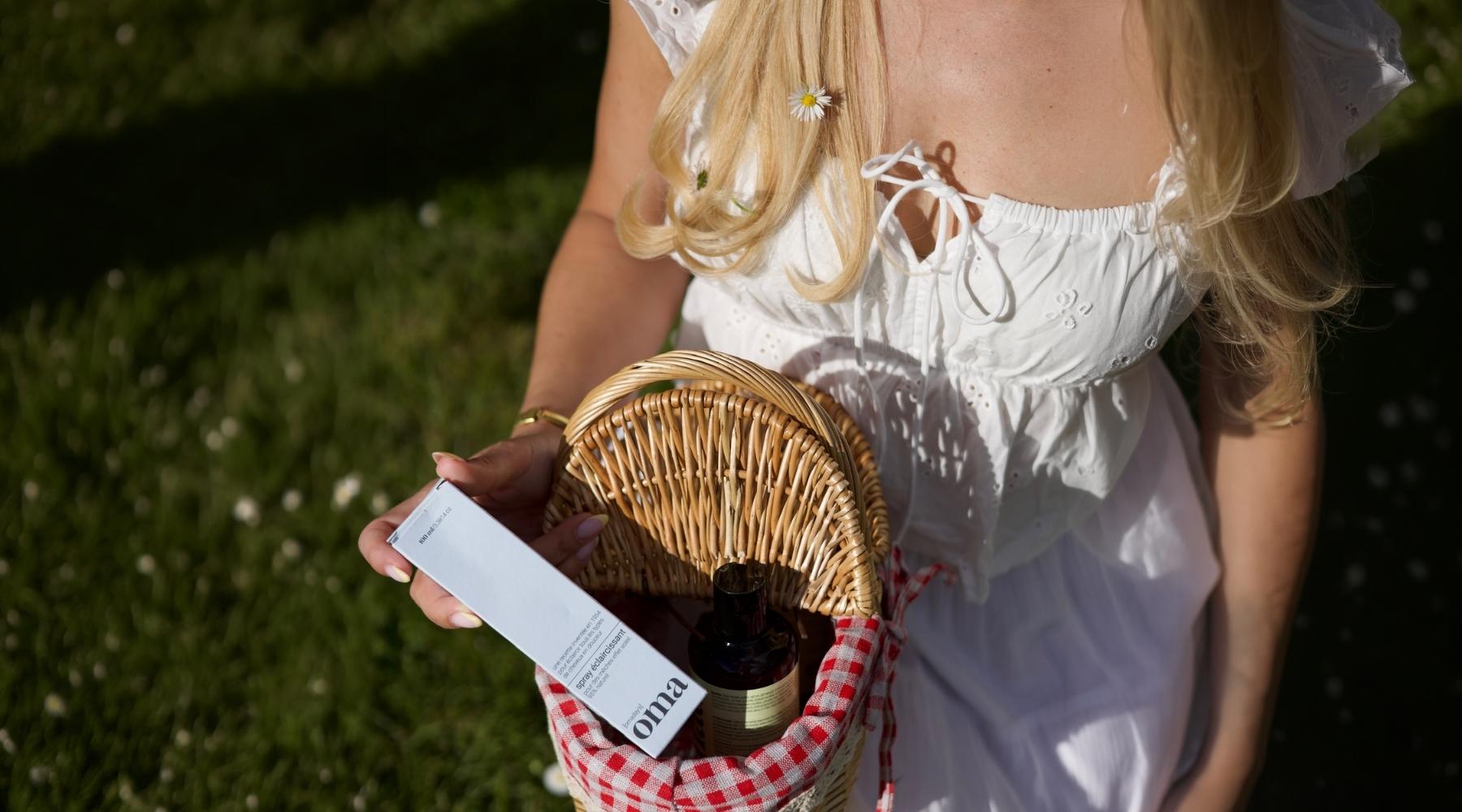
OMAD'S lightening spray: lightens by 2 to 4 tones gradually, 95% of natural origin, score of 100/100 on Yuka.
Discover
A nuanced verdict: which option for which profile?
| Your profile | Best suited option |
|---|---|
| You want an immediate radical change | Chemical bleaching with a professional, accepting the upkeep and the risk to your hair |
| You have a small budget and already light blonde hair | Chamomile as a complement, light effect, no transformation |
| You want to lighten without damage, with a gradual result | 95% natural lightening spray, as a regular routine |
| Your hair is weakened by a recent colour | Spray used gently, one application then observe, or ask our customer service |
| You have grey or white hair that's turning yellow | Neutralising anti-yellow shampoo, not the lightening spray |
Mistakes to avoid
The first mistake is expecting an instant result from a gentle method: neither chamomile nor the spray works like salon bleaching, and that's normal, it's the price of preserving your hair. The second mistake is using lemon thinking you'll save time: the result is uneven and it dries out and weakens the hair over time. The third mistake is skipping regularity: gradual lightening only works if you repeat the step over time. The fourth mistake is using the spray on grey or white hair hoping to lighten it: with no melanin to activate, there's nothing to lighten, only an anti-yellow shampoo corrects the yellowing.
FAQ
Can you really lighten your hair without chemical bleaching?
Yes. A 95% natural lightening spray, used regularly, gains you 2 to 4 tones with no ammonia and no massive oxidation. The result is gradual, not instant, and it preserves your hair far better than classic salon bleaching.
Does lemon lighten hair without damaging it?
No. Lemon lightens a little in the sun, but it dries the hair out badly, leaving it porous and brittle, with an often yellowish, uneven result. It's not a method we'd recommend, despite its visible effect.
Does chamomile really lighten hair?
Yes, but only very slightly, and only on already light hair. It revives golden tones without transforming a dark base. It's an occasional boost of brightness, not structural lightening.
How many tones can you gain without bleach?
With the OMAD'S lightening spray, you can gain 2 to 4 tones gradually, with regular application over several weeks. The first results are visible from the very first application.
Does the lightening spray contain ammonia?
No. The OMAD'S lightening spray is ammonia-free, with a formula that's 95% of natural origin and made of 7 ingredients. It has a score of 100/100 on Yuka.
Does the spray work on grey or white hair?
No. The spray acts on the melanin left in the hair, and grey or white hair no longer contains any, so it can't lighten it. If your grey or white hair is turning yellow, it's better to use a neutralising anti-yellow shampoo rather than the lightening spray.
Can you use the spray on already bleached hair?
Yes, but with care on hair that's very weakened by recent bleaching or a recent perm. In that case we suggest one application, then observing the reaction, before going back to the usual routine. If in doubt, our customer service answers at contact@omadays.com.
In short
Lightening without bleach is possible, as long as you accept the logic of gradual rather than instant. The OMAD'S lightening spray ticks the boxes DIY methods miss: natural, effective, without attacking the hair, on the bases where it genuinely works. Take stock of your base with our free diagnostic, and start your routine gently.