Chamomile for hair: real benefits, how to use it and honest limits
Contents
Chamomile for hair is known for soothing the scalp and slightly reviving the golden tones of already light blonde hair, thanks to its flavonoids. But its lightening effect remains weak, slow and limited to already light bases. On a dark base, it does almost nothing. For a clearer, more consistent result, a 95% natural formula designed to lighten remains more reliable, without damaging your hair.
Blondie, if you're looking for a natural trick for your blonde, chamomile often comes top of the list. And it deserves it: it's a gentle plant, with no risk for the scalp. But before you brew an infusion thinking it'll turn your brown base into golden blonde, it's best to know exactly what it can do, and what it will never do. Let's be honest about it.
What is chamomile and why is it used on hair?
Chamomile (Matricaria chamomilla) is a plant with small white and yellow flowers, used for a long time for its soothing properties. It's rich in flavonoids, including apigenin, an active known for its anti-inflammatory properties and for its slight ability to react with the light pigments in hair under UV light.
It's this gentle reaction that explains its reputation as a "lightening" plant. It doesn't act like a powerful oxidiser: it rather revives the golden tones already present in the hair, a bit like the sun does on blonde hair in summer. That's also why you'll find it in some haircare formulas, including ours, as one of the seven ingredients in the OMAD'S lightening spray.
Is chamomile good for hair?
Yes, chamomile is good for hair: it soothes the scalp, brings softness and slightly revives golden tones on a blonde or light brown base. It doesn't damage the hair and suits most hair types. On the other hand, it has no deep repairing effect, and its lightening action stays minimal: we're talking about a boost of radiance, not a transformation.
As for the scalp, its softening properties make it a good choice as a rinse to calm light irritations. No major contraindication is known, apart from a possible sensitivity to plants in the asteraceae family (like ragweed or daisies). When in doubt, a test on a small strand is always a good idea.
How do you use chamomile on hair?
To use chamomile on your hair, steep dried flowers in hot water for 10 to 15 minutes, let it cool, then use this infusion as a final rinse after shampooing, on damp hair. To boost the effect, let it dry naturally in the sun. Repeat 2 to 3 times a week, over several weeks, to hope for a visible result.
Here are the main ways to add it to your routine, with what you can really expect from it:
| Method | Preparation | Frequency | Expected effect |
|---|---|---|---|
| Infusion as a rinse | Dried flowers steeped 10 to 15 min, then cooled | 2 to 3 times a week | Golden tones revived on a light base, light effect |
| Homemade mask | Infusion mixed with a conditioner | Once a week | Softness, light radiance, no noticeable lightening |
| Sun-drying after application | Application then natural exposure | After each rinse | Boosts the effect very slightly thanks to UV |
What these methods have in common: they require patience, and the result depends a lot on your starting base and your sun exposure.

Does chamomile really lighten hair?
Yes, but very slightly: chamomile only lightens hair that's already blonde or light brown, thanks to apigenin which reacts with UV. On a dark base, the effect is almost nil. The result is slow, counted in weeks, and stays limited to a light boost of radiance, not a real transformation of several tones.
If you want to dig into this specific topic, with the real results observed and the detailed limits, we've dedicated a whole article to it: chamomile to lighten hair. You'll find in particular why this method only works on already light bases, and what really happens when you try the experiment on a brown or dark base.
Does chamomile turn hair yellow?
No, chamomile doesn't turn hair yellow: on the contrary, it wakes up the golden tones already present in a blonde or light brown base. The only risk comes from using it too often combined with strong sun exposure, which can emphasise warm tones on a blonde that's meant to stay cool or polar.
If your blonde is precisely starting to turn yellow or lose its coolness, chamomile isn't to blame, and it isn't what you should use to fix the problem: a neutralising anti-yellow shampoo does that job, not a lightening plant. Chamomile and purple correctors answer two opposite needs: one revives gold, the other neutralises yellow.
What are the limits of chamomile for hair?
Let's be honest about what chamomile doesn't do. It doesn't lighten dark bases, it doesn't repair hair deeply, and its result stays unpredictable: it depends on the strength of the infusion, the number of applications and your sun exposure. There's no way to precisely control the final tone.
Some DIY tips push you to combine chamomile and lemon to "boost" the effect. Bad idea: lemon strongly dries out the hair, makes it porous and brittle, and the result you get is uneven and often yellowish. A gentle plant mixed with an aggressive acid doesn't give a gentle result, it gives an unpredictable result on weakened hair.
Our routine: chamomile in the OMAD'S lightening spray
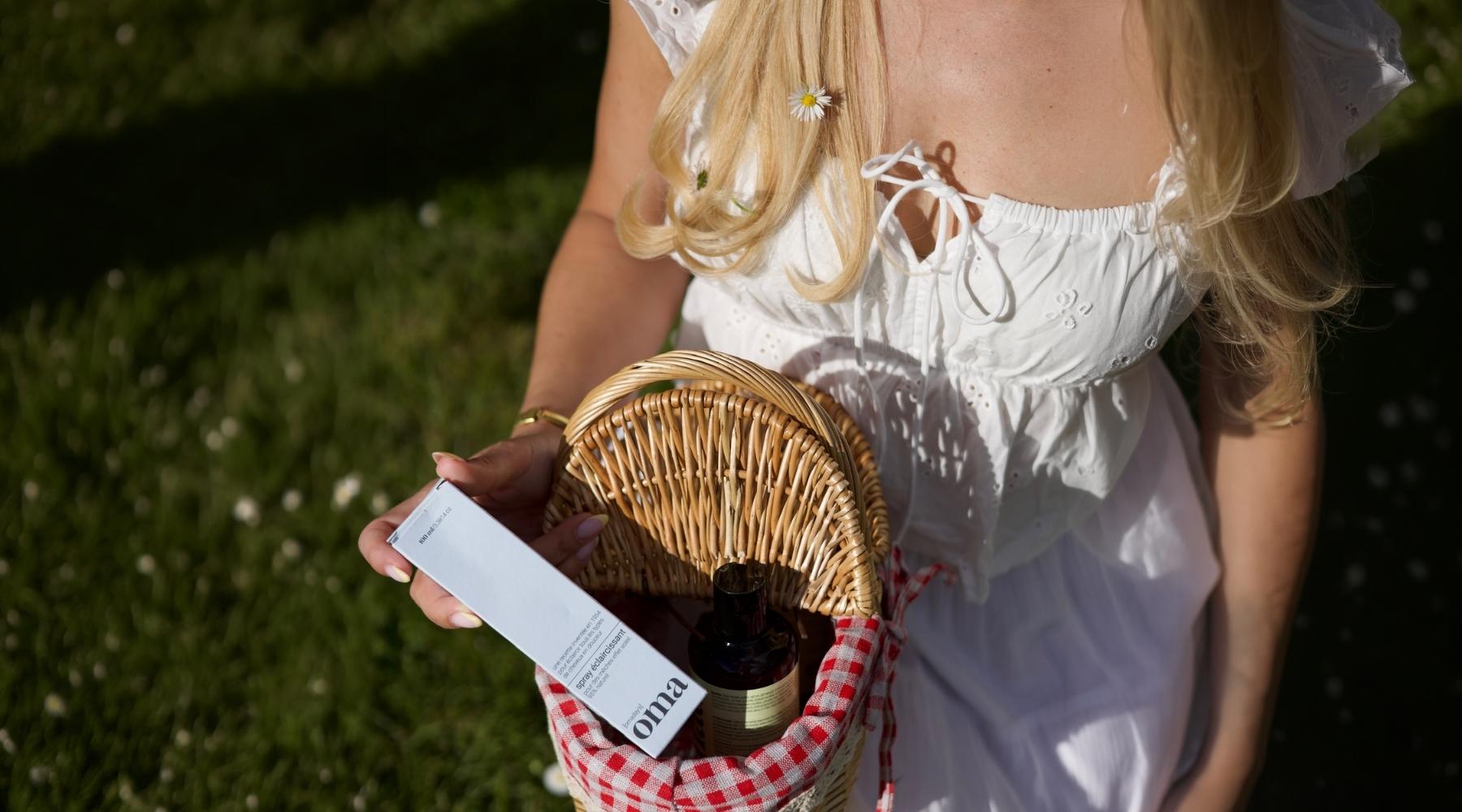
Chamomile is one of the 7 ingredients in the formula of the OMAD'S lightening spray, a 95% naturally derived formula that scores 100/100 on Yuka, ammonia-free. Combined with the other actives in the formula, it contributes to a far more noticeable and consistent lightening than a simple infusion: up to 2 to 4 tones, gradually, while preserving your hair.

The routine stays simple: spray on clean, slightly damp hair, activate with heat (sun, hairdryer, or open air), then repeat every 2 to 3 days at the start, and once a week for maintenance. The first results are visible from the very first application, and build up with consistency. The spray is made in our family lab in Belgium, with organically grown flowers. This formula is actually inspired by a recipe created in the 1950s, which you can discover on our story.

And on your hair, what would it look like?
Answer a few questions and discover the result you can aim for on your colour.
Take my free diagnosisAs for reviews, the spray has an average score of 4.5/5 from 1,702 approved customer reviews. To find out what it would give on your own hair base, you can also take our free hair diagnosis.
The mistakes to avoid with chamomile
- Expecting a fast and spectacular result: chamomile acts slowly, over several weeks.
- Using it on a dark base hoping for a real colour change.
- Combining it with lemon to "boost" the effect: it dries out the hair instead of helping it.
- Staying in the sun for a long time after applying, with no protection at all: that dries out the lengths too.

OMAD'S lightening spray: lightens by 2 to 4 tones gradually, 95% naturally derived, 100/100 score on Yuka
Discover
FAQ
How do you use chamomile on hair? Steep dried flowers in hot water for 10 to 15 minutes, let it cool, then apply as a final rinse after shampooing, on damp hair. Let it dry in the sun if possible to boost the effect. Repeat 2 to 3 times a week, over several weeks, for a gradual and light result.
Is chamomile good for hair? Yes: it soothes the scalp, brings softness and revives the golden tones of an already light base, without damaging the hair. On the other hand, it has no deep repairing effect, and its lightening action stays weak and slow, to be reserved for blonde and light brown hair.
How do you use chamomile on your hair? The principle stays the same whatever your hair type: a concentrated infusion, applied as a rinse on damp hair after shampooing, activated by the sun if possible. On a dark base, though, this method won't give any visible result, it only works on blonde or light brown bases.
Does chamomile turn hair yellow? No, it doesn't turn hair yellow, on the contrary it revives the golden tones already present. A blonde turning yellow comes from other causes (UV, chlorine, old bleaching) and is corrected with a neutralising anti-yellow shampoo, not with chamomile which goes rather in the opposite direction.
Does chamomile really lighten hair? Yes, but very slightly, and only on already light bases. The effect is slow, limited to a light boost of radiance, and invisible on a dark brown base. For more noticeable and measurable lightening, a dedicated formula remains more effective.
How long does it take to see an effect with chamomile? Count on several weeks of regular applications (2 to 3 times a week minimum) before noticing a slight change, and only on an already blonde or light brown base. There's no immediate effect and no guaranteed result.
Chamomile or lightening spray, which one should you choose for a real result? Chamomile on its own is fine for a light boost of radiance on an already light base. For lightening of 2 to 4 tones, gradual and consistent, whatever your starting base, a 95% natural formula designed for that, like the lightening spray, stays more reliable and faster to deliver results.
In short
Chamomile is a gentle plant, useful for soothing the scalp and reviving an already light blonde, but it won't transform a dark base. If you want clearer, gradual lightening without damaging your hair, the OMAD'S lightening spray includes chamomile in its formula, combined with other actives for a more noticeable result. Blondie, it's up to you to see what matches your goal: a simple boost of radiance, or a real change of blonde.