Honey Hair Lightening: Does It Really Work?
Contents
Yes, Blondie, honey can lighten your hair a little: it naturally releases a small amount of hydrogen peroxide when it comes into contact with water. But the effect remains very subtle, slow and unpredictable, most noticeable on already light bases. For a clean, consistent result without drying out the fiber, there are more reliable solutions.
Does honey really lighten hair?
Yes, but with some important nuances. Honey contains an enzyme (glucose oxidase) that, when mixed with water, produces a little hydrogen peroxide, the same oxidizing mechanism used in hair color, but in a natural and highly diluted form. This means honey has real lightening potential, but it's minimal compared to a bleach or a lightening treatment formulated for that purpose.
On dark hair, the effect is almost invisible. On light brown to blonde hair, a few repeated applications can give a slightly more golden glow, without any radical transformation.
How does honey act on the hair fiber?
The mechanism is simple to understand: water activates an enzyme in honey that generates hydrogen peroxide, a molecule that slightly oxidizes melanin (the hair's natural pigment) and lightens it a little. It's the same chemical logic as a classic bleach, but at a much lower concentration and without precise control over the dosage.
That's why the result is very gradual and unpredictable: the amount of peroxide released depends on the honey used, the dilution, the temperature and the leave-in time. There's no way to know in advance how many shades you'll gain, or even whether you'll gain any at all.
How to use honey to lighten your hair?
The basic mix
The most common method involves diluting honey in lukewarm water or conditioner to make it easier to apply along the full length. The mix is then applied strand by strand or over the entire head of hair.
Frequency and leave-in time
Leave-in times are long, often several hours, sometimes overnight, to give the reaction time to work. It's a time-consuming method that needs to be repeated several times to see any visible result, making it impractical for everyday use.
Expected result
Expect a very slight and very gradual lightening effect, distributed unevenly from strand to strand. This is not a method that will transform a light brown base into golden blonde in just a few applications.
What are the real limitations of honey?
The main limitation is unpredictability. You can't precisely control the amount of peroxide released, so you never really know what to expect. Honey does have one genuine plus point though: it's nourishing for the fiber, unlike other DIY methods.
For comparison, lemon is often presented as an alternative, but it's a misleading idea. It lightens slightly in the sun thanks to its acid opening the cuticle, but it dries out and weakens the fiber from within, making it porous and brittle, with a result that's often patchy and brassy. Chamomile, on the other hand, gives a slight brightening effect on already light hair, but has no effect on a dark base.

What would it look like on your hair?
Answer a few questions and find out what result you can aim for with your color.
I take my free diagnosisHoney, chamomile, lemon: what's the difference for natural lightening?
| Method | Mechanism | Real effect | Main limitation |
|---|---|---|---|
| Honey | Releases a little natural hydrogen peroxide | Very subtle and gradual lightening | Unpredictable result, long leave-in times |
| Chamomile | Golden highlights revived | Slight brightness on already light bases | No effect on dark hair |
| Lemon | Citric acid + UV | Visible but uneven lightening | Dries out and damages the fiber from within |
| OMAD'S Lightening spray | 95% natural-origin formula activated by heat | 2 to 4 shades gradually | Requires consistency |
What role does honey play in a routine that protects the fiber?
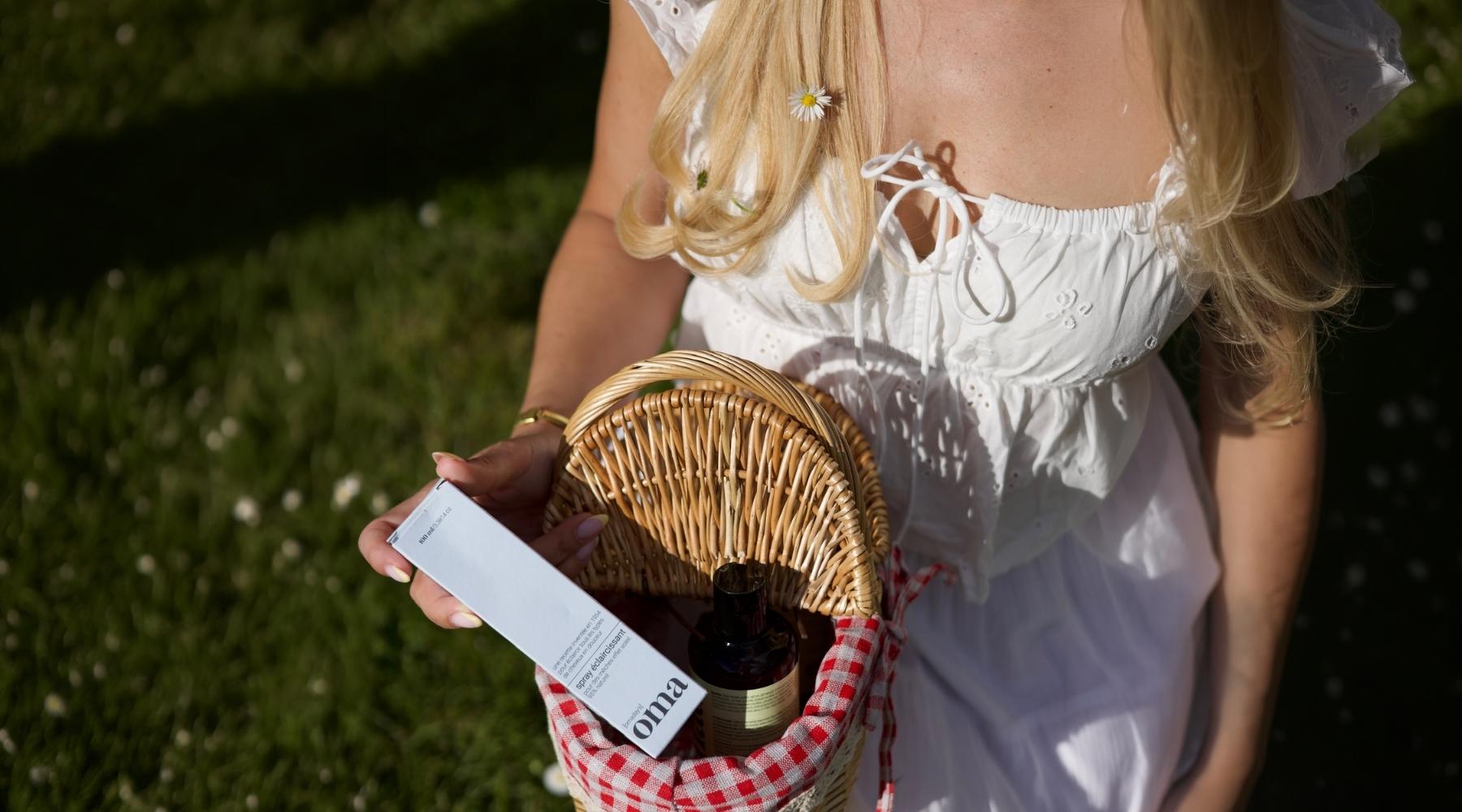
If you're looking for gentle, natural lightening but with a reliable result and without sacrificing the health of your lengths, honey quickly shows its limits. That's where the OMAD'S Lightening spray takes over: a 95% natural-origin formula, rated 100/100 on Yuka, ammonia-free, designed to lighten by 2 to 4 shades progressively.
Unlike honey whose effect is down to chance, the spray works with a clear protocol: spray onto clean, slightly damp hair, activate with heat (sun, hairdryer or open air), then repeat every 2 to 3 days at the start. First results are visible from the first application and become more pronounced with regular use.

One important point: the spray adds no blonde pigment. It lightens an existing base, light brown, dark brown or dark blonde, revealing a more luminous blonde. If you then want to deposit a precise shade onto that already-lightened base, repigmenting shampoos like Blond Vanille or Blond Miel take over, playing a very different role from the spray.

The protocol speaks for itself: the spray has an average rating of 4.5/5 from 1,702 verified customer reviews. It's made in our family lab in Belgium, based on a recipe inspired by Pioupiou's, Zoé's grandmother, who created it in her kitchen over sixty years ago. You can find the full story on the Our story page.
Not sure what result to expect on your hair base? The free hair diagnosis helps you find out exactly what you can expect on your own hair.
Mistakes to avoid with honey
- Expecting a quick or spectacular result: honey's effect is always subtle.
- Leaving it on too long thinking it will speed up the result, without any real extra benefit.
- Combining honey and lemon thinking you'll stack the effects: you mostly stack the risk of dryness.
- Using this method on already weakened hair without caution: it's better to go gently, or avoid it altogether.
FAQ
Does honey really lighten hair?
Yes, a little. Honey naturally releases a small amount of hydrogen peroxide when it comes into contact with water, which can slightly lighten the fiber. The effect remains very subtle, gradual and unpredictable, most visible on already light bases rather than on dark hair.
How do you use honey to lighten hair?
Honey is generally diluted in lukewarm water or conditioner, then applied along the lengths with a long leave-in time, often several hours. The method needs to be repeated several times to see any visible result, with no guarantee of consistency.
How long does it take to see an effect with honey?
There's no fixed timeframe: the result depends on the honey used, the dilution and the leave-in time. Several spaced-out applications are needed before noticing any lightening, and it often stays very slight.
Does honey damage hair?
No, unlike lemon, honey has a rather nourishing effect on the fiber. It doesn't dry out the lengths. Its limitation isn't the risk of damaging the hair, but the unpredictability and weakness of the result.
What's the difference between honey and lemon for lightening?
Honey works gently and nourishes the fiber, but its lightening effect is weak. Lemon lightens more in the sun, but dries out and weakens the fiber from within, with a result that's often patchy and brassy. Neither offers a reliable, clean result.
Does honey work on dark hair?
No, or very little. Honey gives visible results mainly on already light hair, from light brown to blonde. On a dark brown or brunette base, the effect of the natural peroxide released by honey is almost invisible.
What's a natural and effective alternative to honey for lightening hair?
The OMAD'S Lightening spray, with a 95% natural-origin formula, lightens by 2 to 4 shades in a gradual and consistent way, without ammonia. It works with a clear protocol (spraying, heat, repetition), unlike honey whose effect remains unpredictable.
In short
Honey has a real lightening mechanism, but an effect that's too subtle and unpredictable to rely on. If you want a clean, consistent result without sacrificing the fiber, the key is regularity with a formula designed for exactly that. That's the promise of the Lightening spray, to discover on the full OMAD'S range.